
B2B lead generation landing pages: what the data says
Write it for a 12-year-old, then cut it in half. That's the single most useful thing the conversion data says about landing pages, and it's the opposite of how most B2B pages are written. The second lesson is just as important for a small seller: a landing page is one step. The reply you send after someone lands is where the deal starts.
The pages ranking for "lead generation landing page" are screenshot galleries. This one is built on one dataset, Unbounce's Conversion Benchmark Report (41,000+ landing pages, 57 million+ conversions), charted properly, and a 20-point checklist you can run on your own page today.
What a "good" conversion rate is
Unbounce puts the median landing page conversion rate at 6.6% across industries (Unbounce). Half of pages do better, half do worse.
Don't treat it as a target. A page getting traffic from your own email list should beat it easily; a page getting cold paid search clicks may never reach it. Compare yourself to your own last month, by traffic source.
Five things the data says matter
Reading level
Pages written at a 5th to 7th grade reading level converted at 11.1%. Pages written at a professional level converted at 5.3% (Unbounce). Same report, roughly double.
Landing page conversion rate by reading level
The 8th–9th grade bar is derived, not stated: the report says 11.1% is 56% higher than 8th–9th grade pages, which implies about 7.1%.
B2B buyers are clever. They're also busy, reading on a phone between meetings. Plain words aren't dumbing down; they're respect for the reader's time. Run your copy through Hemingway Editor or any readability checker and aim for grade 7 or lower.
Difficult words and length
The report also found a negative correlation of −24.3% between difficult words and conversion rate (Unbounce). In plain terms: the more long, unusual words on the page, the fewer people convert. That's a correlation, not proof that cutting jargon will lift your numbers, but it's free to test.
Decision rule: if your headline has a word of three or more syllables that your buyer wouldn't use out loud, replace it.
| Before | After |
|---|---|
| "Leverage AI-driven insights to optimise your revenue operations" | "See which deals are about to go cold" |
| "Comprehensive bookkeeping solutions for growth-stage enterprises" | "Bookkeeping for UK design studios" |
| "Streamline stakeholder onboarding workflows" | "Get new clients set up in a day" |
Traffic source sets the ceiling
Where visitors come from matters more than almost anything on the page. Average conversion by source, from the same report:
Average landing page conversion rate by traffic source
Email traffic converts best because those people already know you. For a small B2B seller, the lesson is that the warmest traffic, from your list, your network and your conversations, deserves its own page that speaks to people who already know what you do.
Mobile-first
Mobile versus desktop on landing pages
83%
of landing page visits were on mobile
8%
better conversion on desktop than on mobile
Most visits are on phones, but desktop converts better. Design for the phone first, then make sure the desktop version doesn't lose the people who are ready to act. In practice: your call to action must be visible without scrolling on a 375px-wide screen.
One goal per page
Every link that isn't your call to action is an exit. Pick one action, repeat it, and remove the navigation bar if you can. If you want people to book a call, don't also ask them to download a guide, follow you on LinkedIn and read the blog.
Anatomy of a B2B landing page
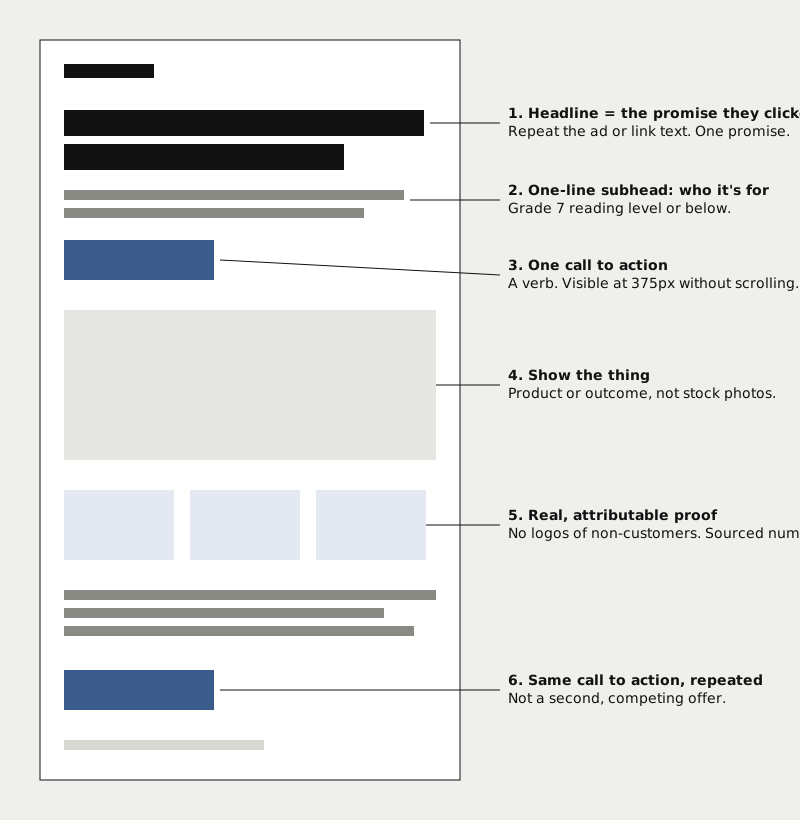
Six blocks, top to bottom. Every block either clarifies the promise or makes it easier to act on.
Teardown checklist: score your page out of 20
One point per yes. 17 or more is solid. Under 12, fix clarity and action first.
Message match
- Headline repeats the promise in the ad, email or link they clicked
- One promise, not three
- A stranger can say what you sell after five seconds
- The subheading says who it's for
Clarity
- Body copy reads at grade 7 or below
- No jargon words of three or more syllables in the H1
- Paragraphs are three lines or fewer on a phone
- Every section heading makes sense on its own
Proof
- Every piece of proof is real and attributable
- No logos of companies that aren't customers
- Numbers have a source
- The page says what happens after the click
Action
- One call to action, repeated
- Button text is a verb describing the outcome
- Forms ask only for what you'll use next
- Every enquiry gets a reply within one working day
Mobile
- Call to action visible without scrolling at 375px
- Tap targets at least 44px high
- Text at least 16px
- No layout jumps while loading on a mid-range phone
After the click: the follow-up is part of the page
A form submission isn't a lead until someone replies to it. For a small B2B seller, the gap between "they filled in the form" and "we had a conversation" is where most landing page wins disappear. Reply the same working day, in plain words, with one question. Our follow-up message guide has templates, and warm leads covers how to tell who's ready for a call.
A practitioner aside: d-gate.io has no form at all, by choice. Our free tools don't ask for an email address either. If someone wants to talk, the conversation starts on LinkedIn, where we'd be replying anyway. That won't suit every business, but it's worth asking whether your form exists because you need the data or because landing pages are supposed to have one.
Landing pages are one channel among several; see how they compare in our ranked list of B2B lead generation strategies.
Where DealGate fits
DealGate works on the step after the page: the conversation. It shows who's warming up or waiting on your reply in your LinkedIn DMs and drafts your next message in your voice. Coming soon: replies auto-send within caps and pacing, with a safety pause if LinkedIn shows a warning. Pricing: $0.99 for your first month, then $29/mo founding price ($49/mo list).
FAQ
What is a lead generation landing page?
A single page built for one action: getting a visitor to start a conversation with you, usually by filling in a form, booking a call or downloading something. It's different from a home page because it has one goal and usually one traffic source.
What is a good landing page conversion rate for B2B?
Unbounce's benchmark report puts the median conversion rate across industries at 6.6%. Treat that as a reference point, not a target: your traffic source sets the ceiling, and email traffic converts far better than paid search in the same report.
How long should a B2B landing page be?
As long as it takes to answer the visitor's questions, in the plainest words you can manage. Unbounce found that copy at a 5th to 7th grade reading level converted at 11.1%, against 5.3% for professional-level copy. Cut words before you cut sections.
Should a B2B landing page have a form?
Only if you'll use every field in the next step. For a small B2B seller, a direct way to start a conversation, such as a reply-to email or a short booking link, often works better than a long form. Ask only for what you need to reply.
Sources
Accessed 10 Oct 2026.
- Unbounce, "Conversion Benchmark Report" (41,000+ landing pages, 57 million+ conversions): https://unbounce.com/conversion-benchmark-report/
- Hemingway Editor (tool mention only, no data): https://hemingwayapp.com
- Before and after headline rewrites are hypothetical examples written by DealGate.
If the landing page is selling a LinkedIn tool, start with the comparisons